We have no FDA approved treatment, no successful placebo-controlled trial, and no accepted biomarkers. That's unacceptable.

Our placebo-controlled rapamycin trial is a strategic opportunity to change this, and you can help.

With your support, we can test rapamycin and a biomarker to help predict who might respond, in a rigorous randomized trial. That's never been done in ME or Long-Covid. Here's how. 

Could Rapamycin pass the placebo-controlled barrier?

Published data from Phase I and early data from Phase II show that some ME/CFS and Long-Covid patients experience significant improvements in fatigue, orthostatic intolerance, and post-exertional malaise (PEM) from low dose rapamycin. Enrolled patients meet the criteria of having PEM.

Now we are ready for the next critical step.

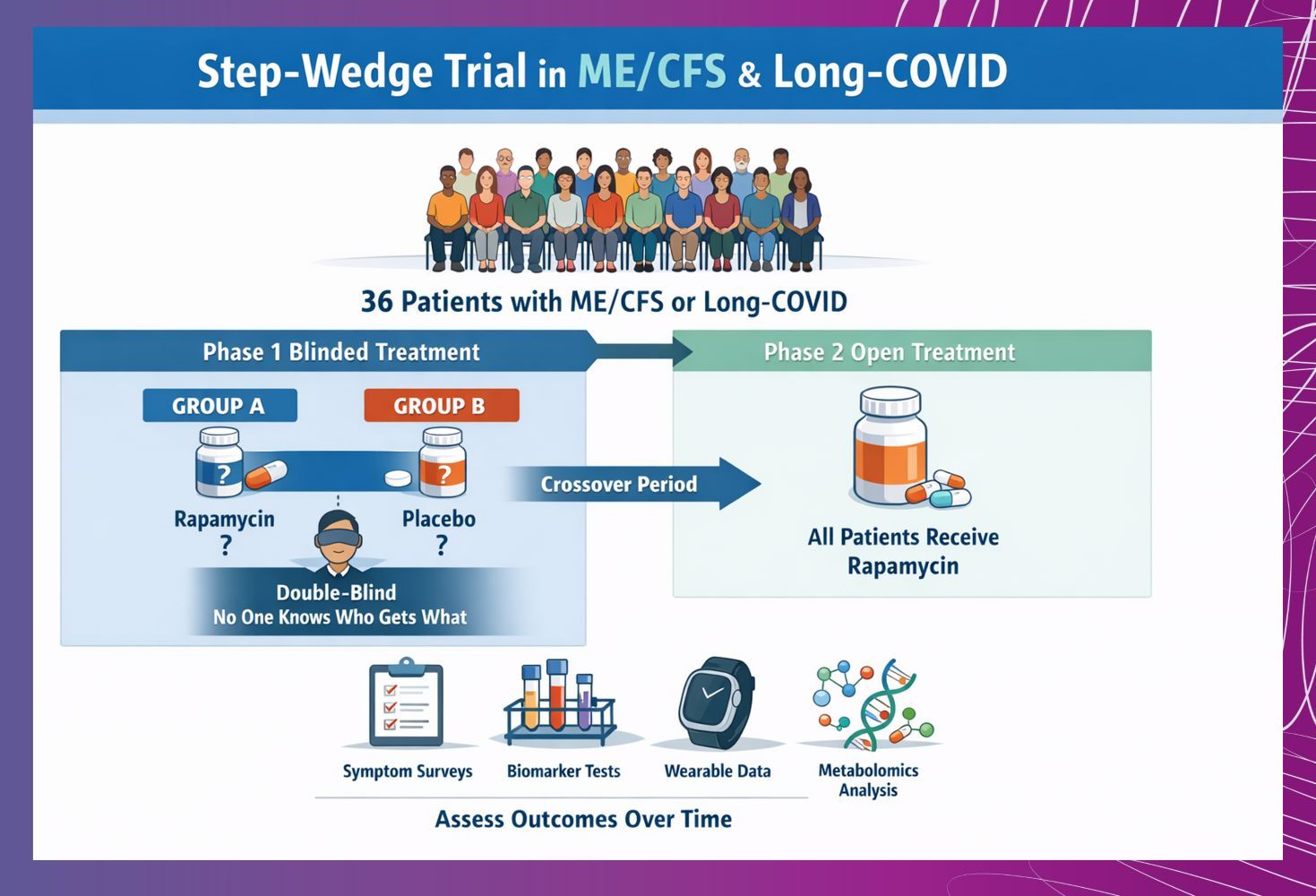
We are launching a double-blind, placebo-controlled step-wedge clinical study nested within our current trial to rigorously test whether rapamycin truly drives these improvements.

This study will:

• enroll 36 participants
• collect specific biomarker and metabolic data to correlate with improvement
• use wearable devices to track outcomes
• generate the first blinded evidence for rapamycin in ME/CFS or Long-Covid

In the step-wedge design, all patients will receive rapamycin following the double-blind, placebo-controlled phase.


Biomarkers Make this Trial Unique in ME & Long-Covid

A key finding in our published results from Phase 1 of the rapamycin study is that specific biomarkers of autophagy correlate with patient improvements. Now we will test that finding under placebo controlled rigor.

Can Biomarkers Predict Response to Rapamycin?

If they hold up, we will have evidence for a test that would predict likely responders to treatment.

That would be a 1st for ME/CFS or Long-Covid. 


Simmaron's Science Behind the Rapamycin Trial

Our new placebo-controlled rapamycin trial is based on 4 peer-reviewed publications of our work on the mechanisms and biomarkers disrupting autophagy in a subset of ME/CFS & Long-Covid patients with PEM.

When our science team published that a patient subset has inactive ATG13 in 2022 (Molecular and Cellular Neuroscience study here), we went on to show how inactive ATG13 is related to mTOR activation, that inactive ATG13 can cause a version of PEM, and how we can reverse it with rapamycin, an mTOR inhibitor. We:

  1. Demonstrated what missing ATG13 looked like in animal models, developing the first mouse models to display post-exertional malaise (PEM) - and publishing our model. (2025 Immunologic Research study here)
  2. Ran a treatment trial of mTOR inhibitor rapamycin to address dysfunctional autophagy caused by inactive ATG13, publishing Phase 1 results in high impact Journal of Translational Medicine and are now preparing a placebo-controlled trial. (2025 study here)
  3. Explained how missing ATG13 in cells causes symptoms of PEM, now describing in publication a cascade of inflammation that implicates new molecules and processes, to drive treatment discovery in the field. (2026 Inflammation Research study here)
  4. Are developing a blood test that can help predict which patients are likely to respond to rapamycin to take the guess-work out of treating ME/CFS. 


We know treatment trials for ME/CFS and Long-Covid will accelerate once the 1st medication proves efficacy in a random controlled trial. We need your support to do that.

White text on a purple background reading
 

Your gift funds concrete steps toward treatment for ME/CFS!


Simmaron Research
948 Incline Way  | Incline Village, Nevada 89451
805-440-2367 | [email protected]

Simmaron Research Inc. is a 501c3 non-profit registered in Nevada.
www.simmaronresearch.com

Follow Us

Having trouble viewing this email? View it in your web browser

Unsubscribe or Manage Your Preferences